Waterfall and River Safety: Understanding Drowning Risks Near Elk Falls
Understanding Drowning Risks in Natural Water Areas
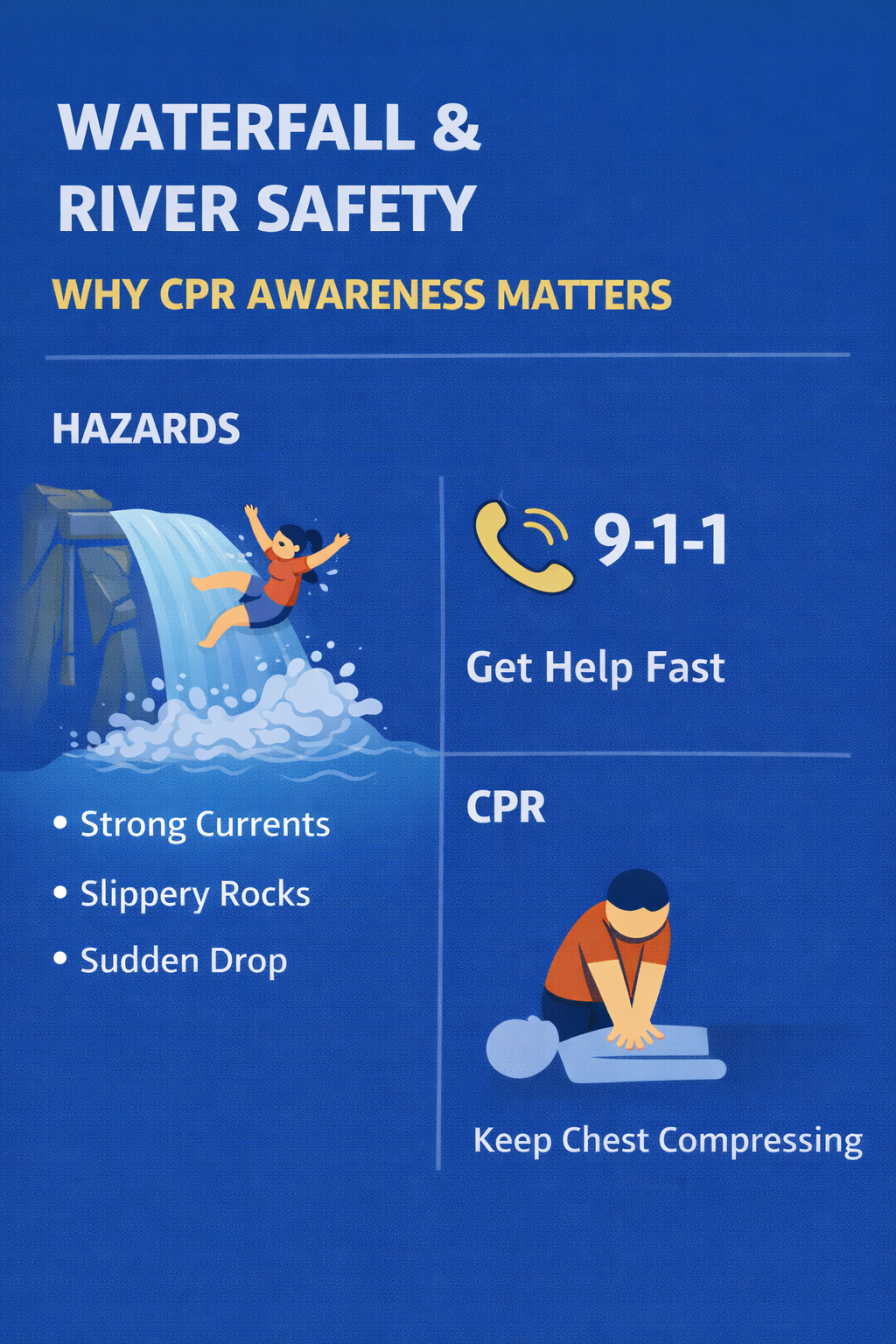
Natural water environments such as rivers, waterfalls, and fast-moving streams can be unpredictable and dangerous. Strong currents, slippery rocks, and sudden drops can create hazardous conditions even for experienced visitors.
When someone falls into fast-moving water, it may quickly lead to breathing difficulties or submersion, which can result in a drowning emergency. In some cases, if a person is rescued from the water and is not breathing normally, cardiopulmonary resuscitation (CPR) may be attempted while emergency responders are on the way.
Across British Columbia, including Vancouver Island and the Vancouver region, many parks and natural areas attract visitors year-round. Because of this, safety awareness and first aid knowledge are often emphasized when spending time near rivers and waterfalls.
A Real-World Scenario
 A tragic incident occurred near Elk Falls Provincial Park close to Campbell River on Vancouver Island involving a tourist visiting the area with her husband.
According to reports, the woman, a Dutch tourist in her 60s, was touring Vancouver Island when she accidentally slipped into the river near Elk Falls. Authorities indicated that she may have been attempting to retrieve an apple that had fallen toward the water when she lost her footing.
Emergency services received a report around 2:20 p.m. that a woman had been pulled into the fast-moving river above the falls. The report came from a third party because the woman’s husband spoke limited English and was unable to clearly explain what had happened.
Police quickly responded and located the husband near the falls. He reported that his wife had slipped into the water and called out for help before being carried away by the current.
A large-scale search operation began immediately. Responders from RCMP, fire services, ambulance services, and local search and rescue teams joined the effort. BC Hydro also assisted by reducing water flow from the nearby John Hart Dam upstream to support the search.
An RCMP helicopter and a drone were used to scan the river area.
Later that afternoon, responders located the woman in the fast-moving waters above the falls. She was retrieved from the river at approximately 5:00 p.m..
Incidents like this highlight how quickly conditions near waterfalls and powerful rivers can become dangerous.
Hazards Near Waterfalls and Fast-Moving Rivers
Areas surrounding waterfalls and river rapids can involve several safety hazards.
Common risks include:
-
Strong currents that pull swimmers downstream
-
Slippery rocks near the water’s edge
-
Sudden changes in water depth
-
Fast-moving water that makes rescue difficult
-
Limited safe access points along steep riverbanks
Even shallow water near rapids can pose serious risks because of the speed and force of the current.
Recognizing Signs of a Water Emergency
A person experiencing distress in water may show signs such as:
-
Sudden disappearance beneath the water
-
Struggling to stay above the surface
-
Calling for help or waving arms
-
Being swept downstream by current
-
Unresponsiveness after being removed from the water
If a person is pulled from the water and is not breathing normally, CPR may be required while waiting for emergency responders.
First Aid Awareness Around Water Emergencies
First aid training teaches general steps that may help during water emergencies.
Typical response steps include:
-
Call emergency services (9-1-1 in Canada).
-
Avoid entering dangerous water conditions if the current is strong.
-
If the person is safely removed from the water, check responsiveness and breathing.
-
If the person is not breathing normally, begin CPR if it is safe to do so.
-
Continue CPR until emergency responders arrive.
In many incidents, trained search and rescue teams handle water recovery and rescue operations when conditions are dangerous.
Prevention and Outdoor Safety Considerations
Visitors to rivers and waterfalls can reduce risks by following basic safety guidelines.
Helpful precautions include:
-
Stay behind designated safety barriers
-
Avoid standing on wet or slippery rocks
-
Maintain distance from fast-moving water
-
Keep personal items away from steep river edges
-
Supervise children closely near water
-
Learn basic first aid and CPR skills
Throughout Vancouver Island and British Columbia, outdoor recreation areas often post safety signage reminding visitors to remain aware of river conditions.
FAQ
Why are waterfalls and river rapids dangerous?
Fast-moving water can pull people downstream quickly, and slippery rocks near waterfalls increase the risk of falls.
What should someone do if a person falls into fast-moving water?
Emergency services should be contacted immediately. Attempting a rescue in strong currents can be dangerous without proper training and equipment.
Why can drowning occur even in shallow water?
Strong currents and turbulence can push a person underwater repeatedly, making it difficult to breathe or stay afloat.
When might CPR be used in a drowning emergency?
If someone is removed from the water and is not breathing normally, CPR may be performed while waiting for emergency responders.
Why is first aid training recommended for outdoor activities?
Training helps individuals recognize emergencies and understand safe response steps until professional help arrives.
Educational Note
This article is intended for general first aid awareness and outdoor safety education. Learning CPR and first aid through certified training programs can help individuals recognize emergencies and respond safely until emergency services arrive.
Serving the Vancouver Lower Mainland with the lowest priced, highest quality safety, CPR, food safe and first aid training since 2010.
 Support local, Canadian-owned businesses, with no connections to American corporations or partnerships.