
A father’s advocacy in Nova Scotia has brought attention to an important issue in emergency response: the public availability and registration of automated external defibrillators (AEDs).
Sudden cardiac arrest can happen anywhere — on a roadway, at work, during exercise, or at home. Across Canada, including Vancouver and throughout British Columbia, improving AED access and public awareness remains a key part of strengthening the chain of survival.
What Prompted the Advocacy
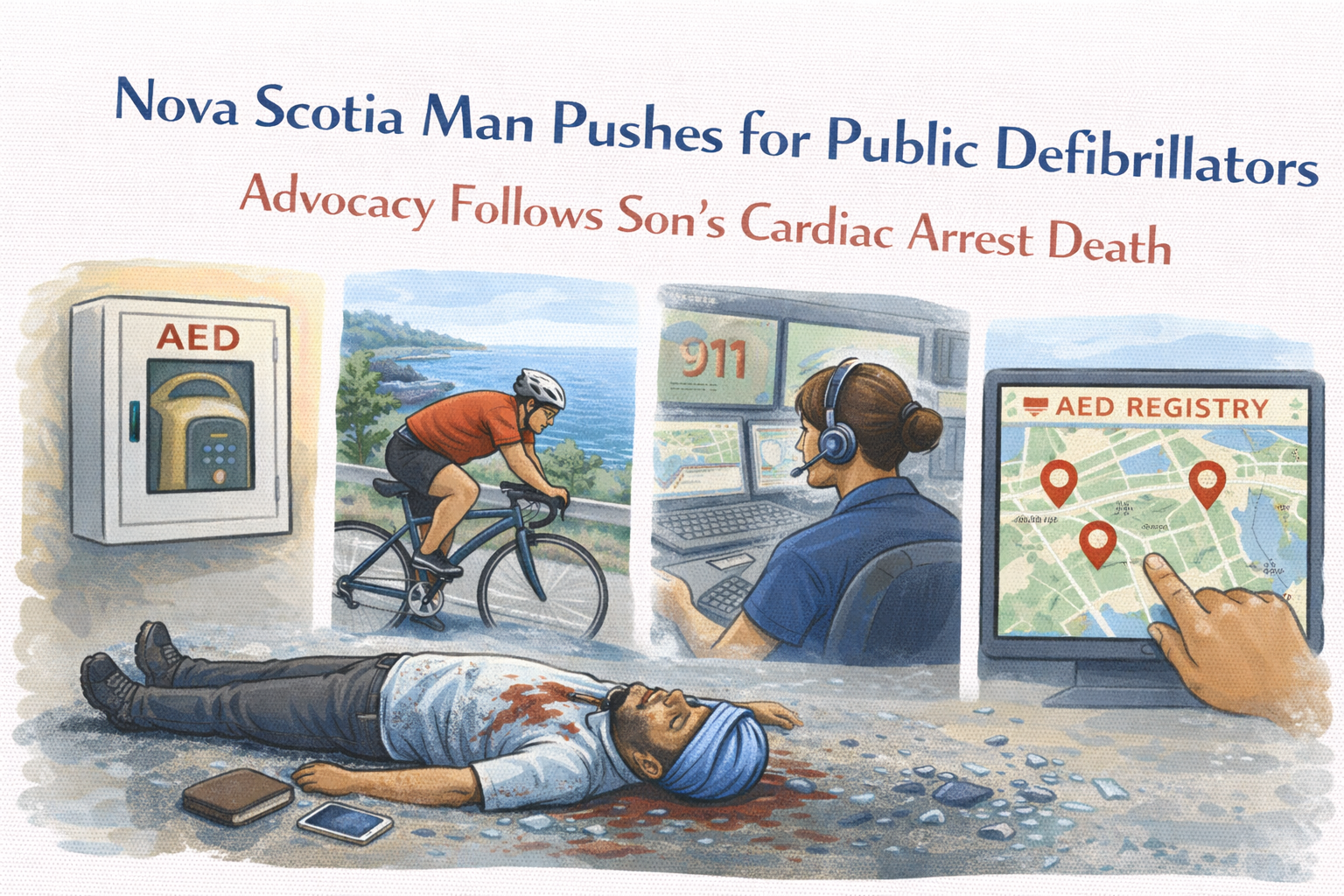
In Nova Scotia, a 28-year-old man experienced cardiac arrest while cycling. Despite emergency response efforts, he did not survive.
In the years that followed, his father began examining how emergency systems operate and identified a gap: emergency dispatchers were not consistently able to direct callers to the nearest registered AED during a cardiac emergency.
Provincial emergency health officials acknowledged that not all publicly accessible AEDs were registered in a central database, limiting dispatcher ability to guide callers to nearby devices. Efforts have since been underway to improve registration systems and mapping access.
Why AED Access Is So Important
 Sudden cardiac arrest occurs when the heart’s electrical system malfunctions, causing it to stop pumping blood effectively.
Without immediate intervention:
-
The person collapses
-
Normal breathing stops
-
Brain injury risk increases within minutes
Survival rates increase significantly when:
-
CPR is started immediately
-
An AED is used as soon as possible
Early defibrillation is one of the most important factors in improving outcomes.
The Role of AED Registration
Many AEDs are installed in:
-
Schools
-
Gyms and recreation centres
-
Offices and workplaces
-
Community centres
-
Retail locations
However, if devices are not registered in a centralized database, dispatchers may not know they are nearby during an emergency call.
An effective AED registry system allows:
-
Real-time mapping of device locations
-
Dispatcher guidance to callers
-
Faster access to life-saving equipment
In British Columbia, several regions maintain AED registries to improve public access and awareness.
How Dispatcher Guidance Supports Survival
In many Canadian provinces, 9-1-1 dispatchers are trained to:
-
Identify cardiac arrest over the phone
-
Provide step-by-step CPR instructions
-
Direct callers to retrieve nearby AEDs when registered
This coordinated response strengthens the “chain of survival”:
-
Early recognition
-
Early CPR
-
Advanced medical care
Recognizing Cardiac Arrest in Public Settings
Cardiac arrest often presents as:
-
Sudden collapse
-
Unresponsiveness
-
No normal breathing
-
No pulse (for trained responders)
If these signs are present:
-
Call 9-1-1 immediately
-
Begin chest compressions
-
Retrieve and apply an AED if available
AEDs are designed to be used safely by the general public and provide clear voice instructions.
Strengthening AED Awareness in BC
For communities and workplaces in Vancouver and throughout BC, improving AED awareness may include:
-
Installing AEDs in accessible, visible locations
-
Registering devices in provincial databases
-
Training staff and community members in CPR/AED use
-
Conducting emergency response drills
-
Clearly marking AED cabinets
Preparedness helps ensure that when cardiac arrest occurs, response is immediate and coordinated.
Frequently Asked Questions
What is an AED registry?
An AED registry is a database that records the locations of publicly accessible defibrillators so dispatchers can direct callers to them during emergencies.
Can 9-1-1 dispatchers tell you where an AED is?
In some regions, yes — if the AED is registered in the system.
Why is early defibrillation important?
The chance of survival decreases with each minute without defibrillation in shockable cardiac arrest rhythms.
Are AEDs difficult to use?
No. AEDs are automated and provide clear step-by-step voice instructions.
Should workplaces register their AEDs?
Yes. Registration improves visibility and helps emergency dispatchers guide callers during cardiac emergencies.
Educational Note
This article is provided for general first aid and emergency preparedness education in Canada. Formal CPR and AED training, along with proper device registration, helps communities respond effectively during sudden cardiac emergencies.
About The Author

Mark Kascha
First Aid Instructor Trainer with 30+ years of experience in CPR, emergency response, and safety training across Canada.
👉 [View full credentials]🔗 View LinkedIn Profile
Last reviewed: March 2026