
 Airports are busy public environments where thousands of travellers pass through every day. Because of the large number of people in transit, medical emergencies can occur unexpectedly. Sudden cardiac arrest is one of the most serious emergencies that can happen in public spaces.
Across Canada, including Vancouver and throughout British Columbia, many public facilities such as airports, transit stations, shopping centres, and sports arenas maintain automated external defibrillators (AEDs) and encourage staff to receive CPR and first aid training. Rapid response from trained individuals can help support survival until emergency medical services arrive.
First Aid and Workplace Safety Relevance in Vancouver and British Columbia
Many airports and transportation workplaces in Vancouver and across BC include CPR training as part of their workplace safety programs. Staff such as airline crew members, security personnel, and airport operations teams may receive training to recognize medical emergencies and assist passengers.
Public access to AED devices is also becoming more common in Canadian transportation hubs. These devices are designed to guide responders through the process of assessing heart rhythm and delivering a shock if necessary.
Early CPR and AED use are key components of emergency preparedness in large public facilities.
Scenario: Medical Emergency at Edmonton International Airport
In a reported incident at Edmonton International Airport (EIA), two airline crew members responded quickly when a passenger collapsed after exiting a flight.
According to airport officials, the passenger had just arrived on a flight from Phoenix to Edmonton and was walking through the airport near Gate 66 when he suddenly collapsed around 4 p.m.
Two flight crew members—Guy Fournier and Elisa Ferrarin—noticed the situation and immediately responded.
Fournier heard an alarm indicating that an AED cabinet had been opened and rushed to assist. When they assessed the passenger, they determined he was unresponsive and showed no signs of a normal heartbeat.
The crew quickly retrieved the AED and attached the pads to the passenger. The device analyzed the heart rhythm and advised delivering a shock.
After the shock was delivered, the AED instructed responders to begin CPR. One crew member performed chest compressions while the other assisted with breaths.
Shortly afterward, the passenger began breathing again and regained consciousness. Emergency responders from the Edmonton International Airport fire crew arrived within minutes, followed by paramedics who took over care.
The passenger’s condition continued to improve as he received further medical evaluation.
Recognizing Signs of Sudden Cardiac Arrest
Sudden cardiac arrest can happen quickly and without warning. Signs that someone may be experiencing cardiac arrest include:
-
Sudden collapse
-
Unresponsiveness
-
Absence of normal breathing
-
Gasping or irregular breathing
-
Lack of a detectable pulse
Recognizing these signs quickly allows bystanders to begin emergency response procedures.
First Aid Awareness: CPR and AED Use
When cardiac arrest occurs, early intervention can help support survival until professional responders arrive.
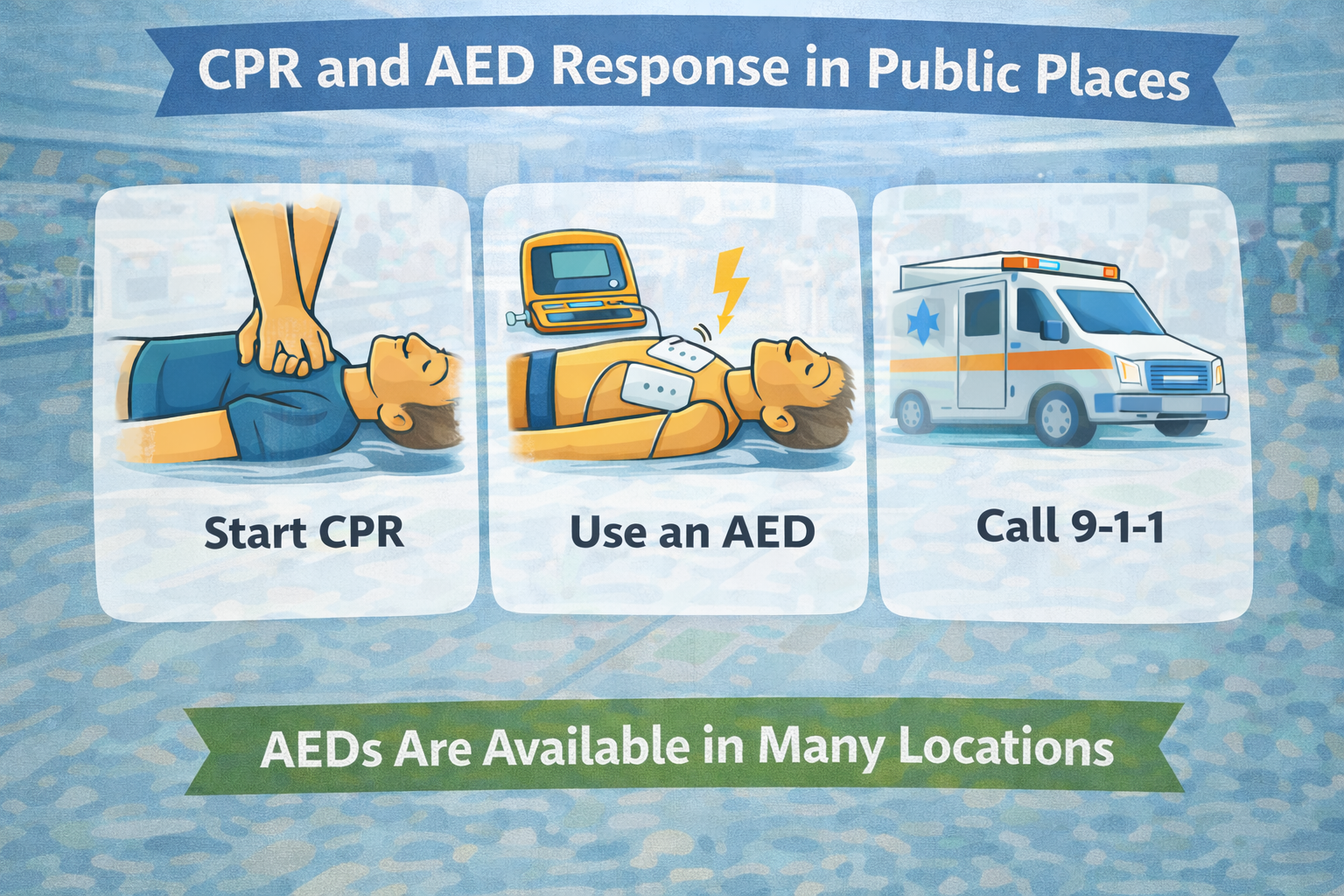
First aid training programs commonly teach responders to:
-
Call emergency services immediately
-
Check for responsiveness and breathing
-
Begin chest compressions if the person is unresponsive
-
Retrieve and use an AED as soon as it becomes available
-
Continue CPR until emergency responders arrive
AED devices provide voice instructions and safety checks that guide responders step-by-step through the process.
Prevention and Emergency Preparedness in Public Facilities
Public facilities such as airports often implement emergency preparedness strategies to improve response times during medical emergencies.
Common safety measures include:
-
Installing clearly marked AED cabinets in public areas
-
Training staff in CPR and emergency response procedures
-
Maintaining accessible communication systems for contacting emergency crews
-
Conducting regular equipment checks for AED readiness
-
Coordinating with local emergency services for rapid response
Across Canadian airports and transportation hubs, these preparedness efforts help ensure that trained individuals and life-saving equipment are available when emergencies occur.
Frequently Asked Questions
What is an AED and how does it work?
An automated external defibrillator (AED) analyzes a person’s heart rhythm and may deliver an electrical shock if needed. This shock can help restore a normal heart rhythm during certain cardiac emergencies.
Why are AEDs placed in airports and public spaces?
Cardiac emergencies can occur anywhere. AEDs placed in public locations allow trained staff or bystanders to respond quickly when someone collapses.
Why is CPR important during cardiac arrest?
CPR helps circulate oxygenated blood to the brain and other vital organs until a normal heart rhythm can be restored.
Can people without medical backgrounds use an AED?
AED devices are designed to guide users with voice instructions. Many first aid and CPR training programs teach individuals how to use them safely.
Why is rapid response important in cardiac emergencies?
The chances of survival decrease with each minute that passes without circulation. Quick CPR and AED use can help support vital functions until paramedics arrive.
Educational Note
This article is intended for general first aid awareness and emergency preparedness education. Cardiac emergencies involve complex medical conditions, and trained emergency responders provide advanced care. Learning CPR and AED awareness can help individuals respond more effectively when unexpected emergencies occur in public places.
About The Author

Mark Kascha
First Aid Instructor Trainer with 30+ years of experience in CPR, emergency response, and safety training across Canada.
👉 [View full credentials]🔗 View LinkedIn Profile
Last reviewed: March 2026