
AED Use at Edmonton International Airport: How Quick CPR and Defibrillation Saved a Life
An automated external defibrillator (AED) is a portable device designed to analyze heart rhythm and deliver a shock if needed to help restore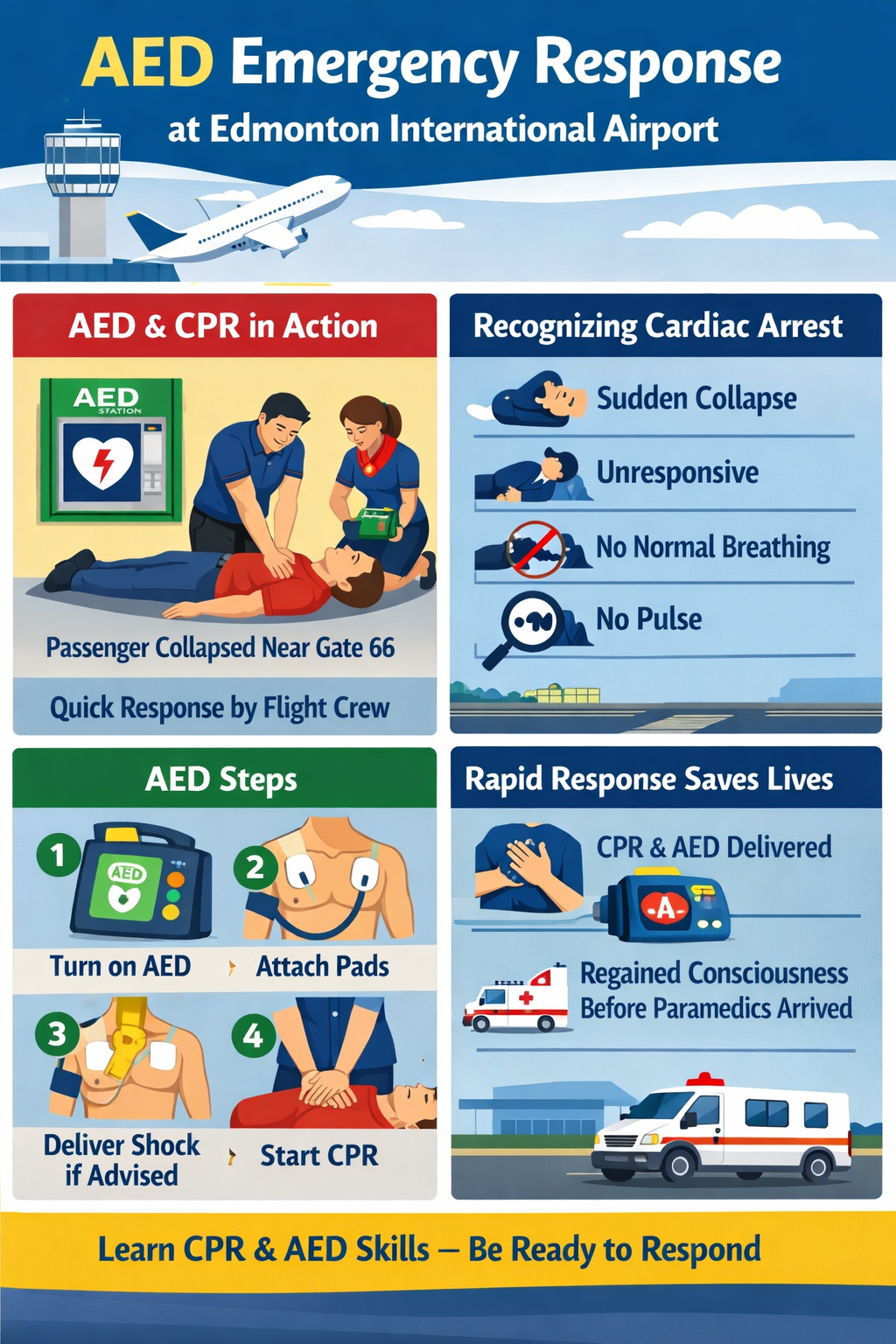 a normal heartbeat during sudden cardiac arrest. When used quickly — along with high-quality CPR — an AED can significantly improve survival outcomes.
In Canada, including across British Columbia and Vancouver workplaces, AEDs are increasingly found in airports, community centres, office buildings, warehouses, and public facilities. Knowing how to recognize cardiac arrest and respond with CPR and an AED is a core component of workplace first aid training.
A Real-World Airport Emergency
In a widely reported incident at Edmonton International Airport (EIA), two flight crew members were credited with helping save the life of a passenger who collapsed shortly after arriving on a flight from Phoenix.
According to airport communications staff, the man had just exited through Gate 66 when he suddenly collapsed and became unresponsive. Two alert crew members noticed that an AED cabinet had been opened and immediately moved toward the scene.
Recognizing the seriousness of the situation, they retrieved the AED, assessed the man, and began CPR. The AED analyzed his heart rhythm and advised that a shock be delivered. After the shock was administered, the device prompted them to begin CPR.
Within minutes of CPR and defibrillation, the man showed signs of improvement. Emergency responders from airport fire services and paramedics arrived shortly afterward and took over care.
This incident highlights how rapid action — even before paramedics arrive — can make a critical difference.
Understanding Sudden Cardiac Arrest
Sudden cardiac arrest occurs when the heart suddenly stops pumping effectively due to an electrical malfunction. Blood flow to the brain and body stops immediately.
Without quick intervention:
-
Loss of consciousness occurs within seconds
-
Breathing becomes absent or abnormal
-
Survival chances decrease significantly with each passing minute
Cardiac arrest is not the same as a heart attack. A heart attack is a circulation problem caused by blocked blood flow to the heart muscle. Cardiac arrest is an electrical problem that stops the heart from beating properly. However, a heart attack can sometimes lead to cardiac arrest.
Recognizing the Symptoms
In public or workplace settings, sudden cardiac arrest may present as:
-
Sudden collapse
-
Unresponsiveness
-
No normal breathing
-
No detectable pulse (for trained responders)
-
Possible gasping or irregular breathing (agonal breaths)
Immediate action is critical.
What Happened During the Response?
In the Edmonton airport incident, the AED played a central role. Modern AEDs are designed to:
-
Analyze heart rhythm automatically
-
Determine if a shock is required
-
Provide clear voice prompts
-
Instruct rescuers when to begin CPR
After the device delivered one shock, the rescuers began cycles of chest compressions and rescue breaths as guided by their training. Shortly afterward, the man began breathing and regained consciousness.
AEDs do not “restart” the heart in the way often portrayed in movies. Instead, they deliver a controlled electrical shock that can stop chaotic electrical activity (such as ventricular fibrillation) and allow the heart’s natural rhythm to resume.
Why Early Defibrillation Matters in Canada
Across Canada, including British Columbia, emergency medical services aim to respond quickly — but bystander CPR and AED use before paramedics arrive dramatically improves survival.
In many Vancouver workplaces:
-
AEDs are installed in visible, accessible cabinets
-
Staff are trained in CPR-C and AED use
-
Emergency response plans include AED retrieval
Workplace first aid attendants are often the first link in the chain of survival.
First Aid Steps for Suspected Cardiac Arrest (Public Education Overview)
If someone collapses and is unresponsive:
-
Ensure scene safety
-
Check responsiveness and breathing
-
Call 9-1-1 or direct someone to call
-
Send someone to retrieve an AED
-
Begin chest compressions
-
Follow the AED’s voice prompts
The AED will only advise a shock if it is needed. It will not shock a person who does not require defibrillation.
Workplace Safety Considerations
In airports, office towers, warehouses, construction sites, and retail environments, cardiac emergencies can occur without warning.
Employers in Vancouver and across BC should consider:
-
Clear AED signage and visibility
-
Regular equipment checks
-
Staff CPR/AED certification
-
Emergency drills
-
Rapid access routes for paramedics
Quick recognition and confident action — as demonstrated in this airport incident — can bridge the critical minutes before advanced care arrives.
Frequently Asked Questions
What does an AED actually do?
An AED analyzes the heart’s rhythm and delivers an electrical shock only if it detects a rhythm that can be corrected by defibrillation. It guides rescuers with voice prompts throughout the process.
Can someone without medical training use an AED?
Yes. AEDs are designed for public use and provide step-by-step instructions. In Canada, Good Samaritan principles support individuals who provide emergency assistance in good faith.
How quickly should an AED be used?
As soon as possible after cardiac arrest is recognized. Early defibrillation significantly increases the chance of survival.
Does CPR still matter if an AED is available?
Yes. CPR keeps blood circulating to vital organs until the AED can analyze the heart and deliver a shock if required.
Are AEDs common in Vancouver workplaces?
Many public buildings and workplaces in Vancouver now have AEDs installed, especially in high-traffic environments. Training ensures staff know how to respond confidently.
Educational Note
This article is provided for general first aid awareness and workplace safety education in Canada. Formal CPR and AED training helps individuals recognize cardiac arrest and respond effectively in real-world situations.
About The Author

Mark Kascha
First Aid Instructor Trainer with 30+ years of experience in CPR, emergency response, and safety training across Canada.
Last reviewed: March 2026
 Support local, Canadian-owned businesses, with no connections to American corporations or partnerships.