Courses, Training, Certification and Recertification in Red Cross First Aid, CPR and AED
Header

What Happened to CPR level B?

May 9th, 2012 | Posted by vanfirstaid in CPR | CPR Questions - (Comments Off)

All CPR and first aid courses undergo modifications and improvements approximately every 5 years. Recommendations and modifications are provided through a large committee on CPR which is associated with the Heart and Stroke Foundation. The general direction of CPR within the past few decades has been towards simplicity and ease of understanding. The large committee group has preached a simpler method for all CPR rescues including CPR for adults, children and infants. With the development of a simpler system CPR level “B” has become outdated as all of its curriculum is now included in CPR level “A”.

Difference Between CPR level’s

Prior to 2005, CPR level “A” (more course information) taught candidates specific rescue techniques for adult victims. CPR level “B” went a step further and taught students rescue procedures for adult and child patients. In 2005, CPR techniques for adult and child victims became almost identical. This made the CPR “A” course almost identical to CPR “B”. In 2005, all of the major providers noticed this change and decided to slowly remove it from the program. By approximately 2007 it became almost impossible to find a CPR “B” course or to become certified in it. Unfortunately, not much was done in terms of candidate awareness. Many CPR “B” candidates who needed to re-certify for employment or school purposes were confused and didn’t know whether to upgrade to CPR “C” (includes infant CPR) or to “down-grade”, without knowing its a identical course, to CPR “A”.

Still Around

To make things even more confusing CPR “B” hasn’t been removed entirely from all the programs. The Red Cross has a childcare first aid program which they operate exclusively. In this program CPR “B” is the only option for students. This continued addition to childcare first aid is the last area where CPR “B” exists. However, childcare first aid will soon modify its program and likely also remove CPR “B”.

In the meantime, it is recommended for everybody that was required to have CPR “B” to maintain certification in CPR level “A”. Hopefully this article clears up the confusion with where the CPR level “B” program has went. For more information about the current CPR “A” or CPR “C” program visit our website course pages for either of those classes.

What is AED Training

May 3rd, 2012 | Posted by vanfirstaid in AED | CPR Questions - (0 Comments)

AED stands for automated external defibrillator and it is a essential component of rescue training. An AED is designed to dramatically increase the chances of survival for victims of cardiac arrest. They are incredibly simple and straightforward to use. AED’s can be found in many recreational centers, stores, and gathering places. As they continue to spread it is essential that as many people as possible learn how to use them. All first aid and CPR training classes (view class list here) offered at Vancouver First Aid include training in the use of AED’s.

Physical Description

An AED is typically a square 20 inch by 20 inch by 4 inch electronic unit with two buttons on it. One button is designed to turn the unit on and the other button is designed to shock the patient (it will not shock anything without analyzing a victim first). Two pairs of pads with electric cords are stored behind, underneath or within the unit. The electric cord is designed to be plugged into the AED while the adult or child pads are placed on the patient. A third pair of pads, for pediatric patients, might be found in more advanced units.

Electronic

An automated external defibrillator is designed to be used on a unconscious patient. The computer components of the AED monitor and check for vitals and shock the patient if the right conditions are present. When a patient enters cardiac arrest the heart enters into a irregular pattern that only a electric shock through a defibrillator can rectify. Chest compression’s combined with the use of a AED increase the chances of survival for victims in cardiac arrest exponentially. Early defibrillation is essential to preventing the loss of life through cardiac arrest. Rescuers only have minutes to implement a AED if the patient is in cardiac arrest before the condition becomes permanently fatal.

Easy Use

Using a AED is extremely easy and straightforward. If the patient does not have any vitals then the defibrillator should be used immediately for adult victims. Remove the AED from the packaging, turn it on and follow the audio and visual instructions. The AED has a number of components that prevent the rescuer from shocking a victim that would not benefit from it.

The rescuer should have no second thoughts or fears of using a AED on a unconscious patient.

All first aid and CPR courses offered through major providers such as the Red Cross include education and effective use in AED’s. Regardless of what first aid or CPR course a student enrolls in he or she will learn how and when to use a AED. All credible providers allow participants to practice the use of AED’s using AED trainers. Participants will be able to use AED trainers on manikins to receive hands-on practice of the use of an AED.

First Aid and CPR Training in the Vancouver Lower Mainland

All Red Cross certification awards state that candidates have received training and are competent in the use of automated external defibrillators.

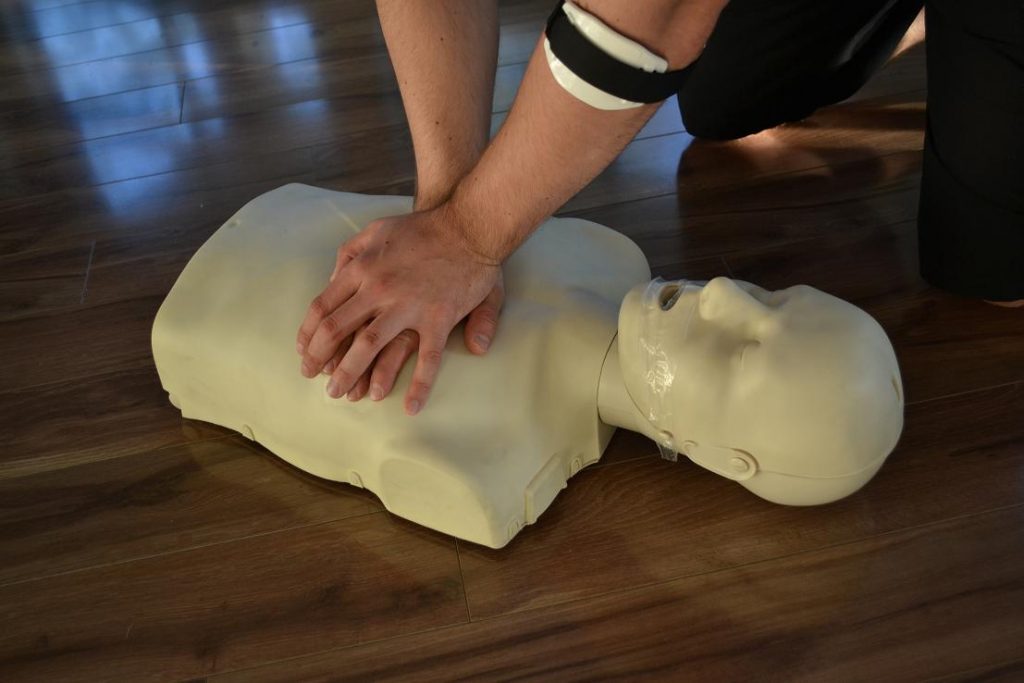
The attached picture shows a manikin and AED trainer that participants will practice with to learn the skills of using a AED while doing CPR.


Canadians are stuck with too many options in the first aid and CPR world. Most participants have to select from 3 different first aid courses and in some parts of Canada have to select from at least 4 different levels. CPR training is not much different. Participants can select from at least 3 different CPR level’s. All courses include CPR and all courses include training in the use of automated external defibrillators (AED). The type of CPR course a candidate needs is determined by several options. If a candidate is required to have a certificate for school, volunteer or workplace purposes I strongly recommend that they contact the employer or program administrator to determine the required level of CPR. If a candidate is taking the CPR course for educational purposes only then this article should really help. Prior to registering for any CPR course participants should be aware that no first aid training is included in stand-alone CPR courses. Fortunately, all first aid courses include CPR training. This page will outline the different levels of available CPR courses to Canadians.

Basic CPR

The simplest, quickest and most basic course is CPR level “A”. This course covers essential CPR components including CPR for adult and child patients. Candidates will also learn to recognize and provide care for patients with breathing emergencies such as choking. Participants will also cover topics such as contacting EMS and legal implications of doing CPR. Typical candidates include people that work in the service, fitness and care industries, specifically with adults.

Comprehensive CPR Training

The most popular and one of the most comprehensive CPR courses is CPR “C”. This course includes all of the material offered in CPR “A” and the CPR “C” certificate can substitute a CPR “A” award. In this course candidates will not only learn CPR techniques for adult and child patients but will also learn to treat and care for infant patients. This course is slightly longer than CPR level “A” and includes all of the breathing emergency components.

Health Care Provider Level

The most detailed CPR course is CPR “HCP” which is designed for people that work in the health care industry. This course covers all of the material included in CPR “A” and “C” and adds additional training with the use of advanced equipment and trained assistance. This course is slightly longer than CPR level “C”. Typical candidates include health care workers, health care administrators, and nursing and medical students.

Prior to registering for any course it is important for candidates to determine if they need a CPR “only” course or if they need a combined first aid and CPR course. All first aid and CPR courses include training in the use of automated external defibrillators. Participants should also determine the level of CPR training they are required to have for workplace, volunteer or school purposes. Most candidates opt for CPR level “C” which is easily the most popular course among all three. All CPR courses will teach candidates the basic skills to help preserve and save a life.


Question: Would you be able to go through some basic procedures for seizures? We work with children with autism and a few of them have seizures. Will this information be covered in Red Cross childcare first aid training courses (vancouverfirstaid.ca/first-aid-courses/childcare-first-aid-courses)?

Types of Seizures

Patients of seizures can be divided into two different categories. Seizures can occur once in a lifetime from a blunt force trauma or hit to the head. When a patient has chronic seizures then the patient is likely epileptic. Patients that are epileptic are typically aware of the condition and can be medicated to reduce the severity and frequency of the seizure episodes.

Being Prepared

When working with children that are susceptible to seizures it is important to have good communication with the parents and caregivers of the child. Ask the parents or caregivers if the child has any triggers for the seizure and how to avoid the onset and frequency of the seizures. Some patients can also be aware if a seizure is oncoming so I would recommend having a plan in place when children advise you or your staff if they feel a seizure oncoming. Some patients can predict a seizure episode and give a warning as long as 60 seconds. The ideal situation would be if the patient advises the staff of a oncoming seizure and then place him or herself in the ideal position and place. The ideal position is with the victim flat on his or her back, with no furniture or material around the victim to avoid injury. If possible have a blanket or pillow behind the patients head to prevent the head from impacting the ground or floor too forcefully.

When the Seizure Happens

If a child has a seizure without warning I would quickly place the child onto the floor and move any furniture away from the patient to allow the extremities and the body to move freely without hitting anything. DO NOT try to restrain the child as the seizure is happening. DO NOT place anything into the child’s mouth as it will likely become a choking hazard. The rescuer(s) should also focus on protecting the child’s head by placing a blanket or pillow behind it. If none are available you can place your hands behind the child’s head (palm’s up) to protect the head from impacting the floor.

After the Seizure

The seizure will likely stop within one minute. The patient may be unconscious after the seizure so it is important for the rescuer to check the patient’s vitals and treat appropriately. If vitals are absent  contact EMS immediately and begin CPR. If the patient awakes from the seizure do not expect him or her to be fully conscious or aware immediately after. Expect the patient to be confused, unaware and disoriented for up to an hour after the seizure. Monitor the patient and if the patient’s condition does not improve contact EMS. Rescuers should also recognize and care for any other injuries as a result of the seizure (e.g. from hitting objects).

When to Contact EMS

If this is the first seizure episode or if the patient is not susceptible to seizures contact EMS. I would also contact the caregivers and let them know of the situation. Good communication between the staff, patients and the caregivers is essential in effectively managing patients that are susceptible to seizures.

If ever the situation does not improve or if the patient’s condition does not improve contact EMS. To learn more about managing seizures take a standard or emergency childcare first aid course. Seizure management and over a dozen other first aid topics are included in these Red Cross first aid courses. CPR training and the use of automated external defibrillator is also included.

Many people are unaware or do not know which first aid or CPR course they are required to have. Throughout Canada must customers have a handful of courses to select from with emergency first aid, standard and childcare first aid being the most popular. However, British Columbian’s have an added complication with the occupational first aid program developed by WorkSafe BC. This page will hopefully outline the difference between the basic first aid program offered through the Red Cross, Lifesaving Society and Heart and Stroke Foundation versus the occupational first aid program.

Occupational First Aid Program

The occupational first aid (OFA) program offers three main first aid training classes. The most popular and shortest is occupational first aid level 1 (OFA level 1). This course is extremely similar to emergency first aid. Both courses are 8 hours in length and cover almost identical topics. OFA level 1 covers a bit more administrative and workplace issues.  Certificate offered by both these programs are completely different. It’s like comparing apples and oranges. Contact your employer or school to determine which one you need because they rarely substitute for one another.

Occupational first aid level 2 (OFA level 2) is a unique course that is 36 hours in length. Its a one and only course that is difficult to compare to any other course.

Occupational first aid level 3 (OFA level 3) is also a very unique 72 hour course. People throughout Canada flock to BC to take this course. No confusing this course with any basic first aid program.

OFA level 1 Versus Emergency First Aid

This two first aid programs are the most similar with both taking 8 hours to complete and both being labelled “basic first aid”. Both courses have certificates that last for 3 years and each class includes basic CPR training. Contact your employer, don’t ask us which one you need. If you have the option to choose I would recommend emergency first aid because it is likely cheaper and re-certifying courses are available when you need to renew in the future.

All in all it doesn’t matter which course you take because both courses provide exceptional first aid and CPR training.


The material posted in this blog is for information purposes only. If you wish to learn the new and updated methods of treating for deadly bleeding take a emergency first aid or standard first aid course in Vancouver or anywhere in the Lower Mainland with Vancouver First Aid Ltd.

The popular acronym for treating victims of deadly bleeding has been, for more than a decade, RED. Rest and Reassure, elevate and direct pressure. The acronym is simple to teach and understand, especially since the color of blood is RED. However, the acronym RED has been removed from the standards of first aid with the Red Cross and the Lifesaving Society. It has been replaced with just applying direct pressure and resting / reassuring the wound and the victim. The rationale for the removal of elevation from the treatment of deadly bleeding is that it is difficult to apply adequate pressure on an elevated limb, its more uncomfortable for the victim and can aggravate other injuries that the victim may have. Candidates in standard first aid and emergency first aid courses will no longer be taught about elevation when treating for deadly bleeding.

Furthermore, the application of a turniquet to deadly bleeding has also been removed from the curriculum of standard first aid and emergency first aid courses. The rationale behind this is that many rescuers who improperly tie a turniquet create more complications and decrease teh chances of survival for the victim and for the injured limb. Therefore, candidates are no longer taught to tie turniquets for victims of deadly bleeding.

To register for a standard first aid course or recertification / refresher course select the course from the sidebar or menu bar. For a private course for you or your business contact us via phone at 778.709.9180, email at info@vancouverfirstaid.ca or use our “contact us” page.

This page is designed to help candidates understand the difference between the three major Red Cross first aid programs which include emergency first aid, standard first aid and childcare first aid. These courses have a number of similarities however they do have a significant number of differences. This page outlines the course content of all three of these courses.

Childcare First Aid

Course Length: 8 hours

Material: Childcare First Aid Manual

CPR: CPR Level B (Adult and Child)

Topics Covered:

  • Introduction
  • The Red Cross
  • Preparing to Respond
  • The EMS System
  • Check, Call, Care
  • Airway Emergencies
  • Breathing and Circulation Emergencies
  • First Aid for Respiratory and Cardiac Arrest
  • Head and Spine Injuries
  • Bone, Muscle, and Joint Injuries
  • Wound Care
  • Sudden Medical Conditions
  • Environmental Emergencies
  • Poisons
  • Keeping Children Safe

Certificate: Red Cross Childcare First Aid Certification includes CPR B and AED (Valid for 3 years)

Emergency First Aid

Course Length: 8 hours

Material: Red Cross First Aid and CPR Manual

CPR: CPR Level A (Adult Only) (CPR C available upon request)

Topics Covered:

  • Introduction
  • The Red Cross
  • Preparing to Respond
  • The EMS System
  • Check, Call, Care
  • Airway Emergencies
  • Breathing & Circulation Emergencies
  • First Aid for Respiratory & Cardiac Arrest

Certificate: Red Cross Emergency First Aid Certificate includes CPR A and AED (Valid for 3 years)

Standard First Aid

Course Length: 16 to 18 hours

Course Material: Red Cross First Aid and CPR Manual

CPR: CPR Level C (CPR HCP available upon request) (Adult, Child and Infant)

Topics Covered:

  • Introduction
  • The Red Cross
  • Preparing to Respond
  • The EMS System
  • Check, Call, Care
  • Airway Emergencies
  • Breathing & Circulation Emergencies
  • First Aid for Respiratory & Cardiac Arrest
  • Head & Spine Injuries
  • Bone, Muscle & Joint Injuries
  • Wound Care
  • Sudden Medical Emergencies
  • Environmental Emergencies

Certificate: Red Cross Standard First Aid Certificate includes CPR C and AED (Valid for 3 years)


A frequently asked question when people take a first aid or CPR course is: what should i wear? As a first aid instructor I have seen people coming in wearing stilettos, high heel boots and mini skirts. However, when taking a first aid course you are going to need to move around quickly and be very comfortable. CPR, when performed properly, needs to be done on a firm and flat surface. This means that when doing CPR, the rescuer will most likely be kneeling on the floor. Furthermore, you are going to be coming up and down from the floor several times making it somewhat uncomfortable in mini skirts or high heels.

I highly recommend that you wear comfortable clothes and clothes that you won’t worry about kneeling with. Runners or comfortable shoes are also important. Its unsafe to be running around in high heels trying to stay calm in a mock panic scenario. Shorts, jogging pants, runners and a comfortable top work great. No need to wear formal attire. First aid courses aren’t formal events. So be comfy, sit back and enjoy the show. Register for a first aid class in Vancouver today.

How to prevent infants from Choking.

July 4th, 2011 | Posted by vanfirstaid in CPR | CPR Questions - (Comments Off)

The information posted in this blog is for information purposes only. If you wish to learn to treat and recognize first aid emergencies register for a first aid course in Vancouver with Vancouver First Aid Ltd.

The highest method of accidental deaths for infants in North America is via choking. Fortunately, there are two easy ways to prevent infants from choking. One simple method is prevention. I have spoken to an anesthesiologist from a local children’s hospital and he explained to me that infants and young children will choke on EVERYTHING! He has been part of surgical teams removing everything from batteries, lego’s, coins and candy’s from the passage ways of you children and infants.  If they can put in in there mouth they can choke on it. The simplest way to prevent any choking is to prevent it from happening. As they get older, sausages and grapes are the most likely culprits of causing young children, and adults to choke. Cut the grapes in half or in quarters and cut up the hot dog sausages before feeding them to the children. Use common sense around the babies crib, kitchen and with everything they eat. The best way to stop your infant or child from choking is to prevent it from every happening.

Another method of preventing your child or infant from becoming a fatal statistic from choking is by learning CPR. CPR teaches people straight forward and simple methods of rescuing choking victims. Combinations of abdominal thrusts and back blows have a very high statistic of removing a choking obstruction and saving an Adult, infant or Child. Take a CPR course in Vancouver today and learn to save the life of a loved one.

Vancouver First Aid Ltd offers CPR and first aid courses throughout BC in comfortable classrooms in no-pressure and fun environments. We offer the cheapest courses at the most convenient locations. All courses are affiliated with either the Red Cross or the Lifesaving Society.  Register for a course today.

How long is my CPR certification valid for?
It is dependant on what provider you received your certification from. Red Cross courses offer certification which is valid for 3 years. However, you should check with your employer, because, they set what the recertification time period is.

Can I get a Red Cross or Lifesaving Society recertification eventhough I didn’t originally get my certification from them?
Yes, you can. As long as you received your certification from a credible provider and you have your previous certification card with the date of certification on it you can. You are eligible for both CPR and first aid re-certification training.

How long can it be before I have to retake the entire  first aid or CPR course?
It depends on the provider, but the general rule is that you have 5 years from the last certification course you took to recertify. After that, you will likely have to redo the entire course.

What is Basic Life Support First Aid?
It is the equivalent of Emergency First Aid or Standard First Aid.

What is Basic Life Support CPR?
This is the equivalent of CPR level A or CPR level C.

What CPR of First Aid course should I take?
It really depends on the program you want to get into. Check with your school or your employer.

What is AED training?
AED stands for Automated External Defibrillator. Training to use an AED has become mandatory for all Red Cross and Lifesaving Society Providers. An AED increases the chances of revival during CPR by as much as 4 times. Every CPR or First Aid course offered by Vancouver First Aid offers AED training.

What should I wear to my first aid or CPR course?
Wear comfortable clothing. You are going to be moving around quite a bit and you want to be comfortable.

How are you different from St. Johns Ambulance?
We aren’t, we offer the same equivalent courses.

Do you ever cancel a first aid or CPR course or renewal course?
Never, we promise to offer to never cancel any course.

How can I pay for my course?
Visa, cash, paypal or credit card. We promise to remain flexible and as convenient as possible to our customers.

When will my certification be mailed to me?
The certification card will be mailed to you within two months of the course. You will be issued a temporary card in the meantime.